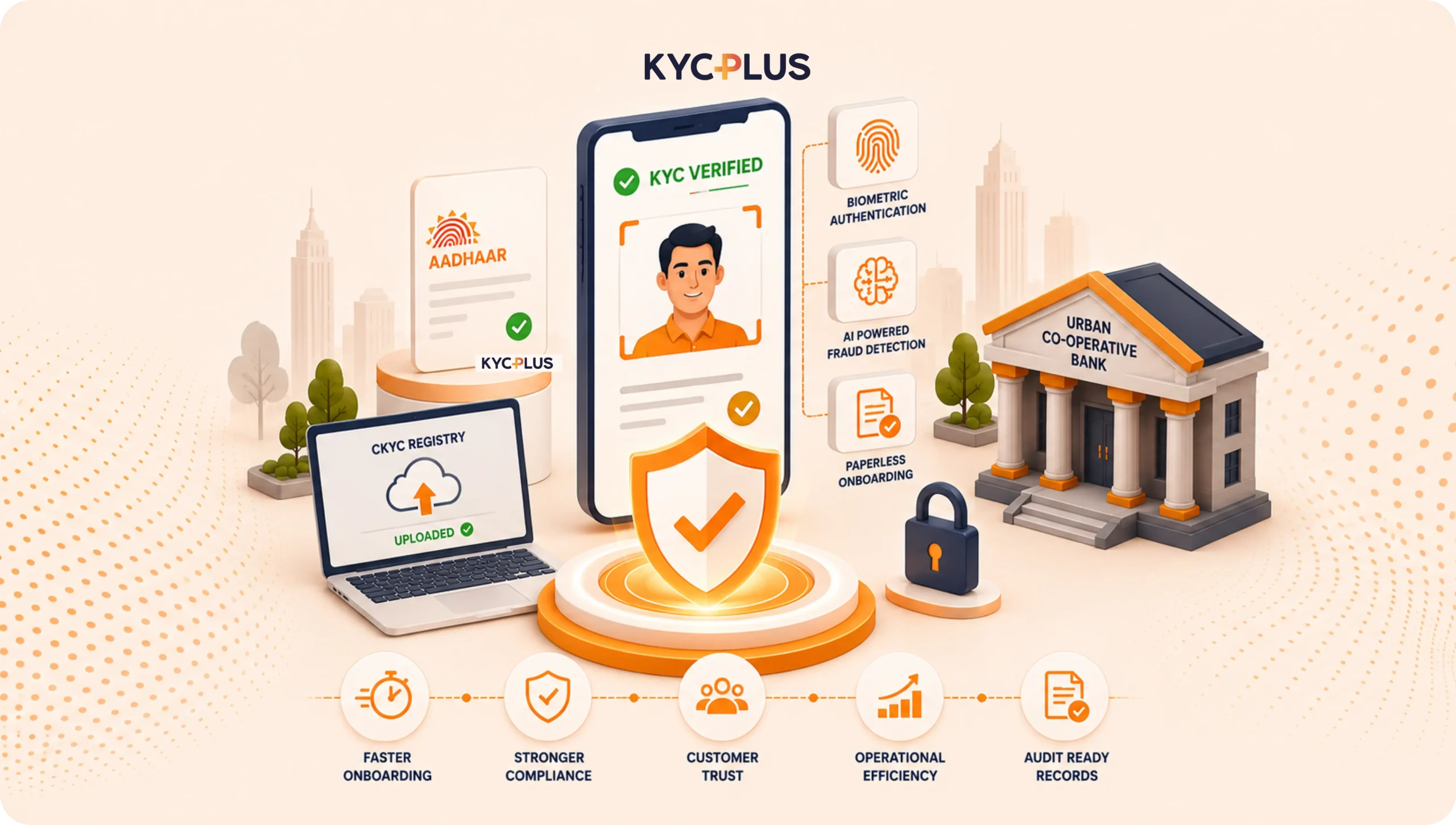
In India’s financial ecosystem, compliance and customer identity verification are critical. Two terms often used interchangeably — KYC (Know Your Customer) and CKYC (Central KYC) — actually represent different processes. Understanding the distinction is essential for banks, NBFCs, cooperative societies, and fintechs that want to remain regulator‑friendly while delivering seamless customer experiences. This blog explores KYC vs CKYC, highlighting their definitions, processes, benefits, and differences. By the end, decision‑makers will have a clear roadmap to choose the right approach and the right partner among the Best CKYC Verification Service Provider in India.
KYC (Know Your Customer) is the process of verifying a customer’s identity before allowing them to access financial services. It involves collecting documents like Aadhaar, PAN, Voter ID, or Driving License, and validating them against regulatory standards.
CKYC (Central KYC) is a centralized repository maintained by CERSAI (Central Registry of Securitisation Asset Reconstruction and Security Interest of India). Once a customer completes KYC with one institution, their record is uploaded to CKYC and assigned a unique CKYC number.
Understanding KYC vs CKYC is crucial for institutions:
This is why cooperative banks, NBFCs, and fintechs increasingly partner with the Best KYC Verification Service Providers in India to integrate both KYC and CKYC seamlessly.
When comparing KYC vs CKYC, the most important distinction lies in scope and process. KYC (Know Your Customer) is institution‑specific — each bank, NBFC, or cooperative society collects and verifies customer documents like Aadhaar, PAN, or Voter ID independently. This often leads to duplication, as customers must repeat the process whenever they engage with a new financial institution.
On the other hand, CKYC (Central KYC) is a centralized system managed by CERSAI. Once a customer completes KYC with one institution, their verified record is uploaded to the CKYC Registry and assigned a unique CKYC number. This number can then be used across multiple banks, NBFCs, and insurance companies, eliminating the need for repeated submissions.
In short, KYC vs Central KYC can be understood as individual verification versus centralized verification. KYC ensures compliance at the institutional level, while CKYC standardizes identity records nationwide, reducing duplication and improving customer convenience. For regulators, CKYC simplifies reporting; for institutions, it lowers operational costs; and for customers, it delivers trust and transparency.
The distinction between KYC vs CKYC is not just technical — it has real implications for compliance, fraud prevention, and customer experience in India’s financial sector. Both processes play a vital role, but understanding their importance helps institutions choose the right approach and avoid costly mistakes.
KYC ensures that every financial institution verifies its customers according to RBI and SEBI guidelines. Without proper KYC, banks and NBFCs risk penalties and reputational damage. CKYC, on the other hand, centralizes these records under CERSAI, making compliance easier to monitor and standardize across institutions. This is why regulators emphasize both KYC and CKYC — and why institutions must understand KYC vs Central KYC to remain compliant.
Fraudsters often exploit gaps in manual KYC processes by submitting forged documents or creating synthetic identities. CKYC reduces this risk by maintaining a centralized, tamper‑proof record that can be cross‑verified across institutions. In practice, KYC vs Central KYC represents the difference between isolated verification and a unified fraud prevention system.
From a customer’s perspective, repeating KYC at every institution is frustrating. CKYC solves this by allowing one verified record to be reused across banks, NBFCs, and insurance companies. This convenience builds trust and loyalty. Institutions that understand KYC vs Central KYC can deliver smoother onboarding experiences while staying regulator‑friendly.
Manual KYC requires staff to handle paperwork, verify documents, and update records repeatedly. CKYC reduces duplication, saving time and resources. For cooperative banks and NBFCs managing large customer bases, the efficiency gained by adopting CKYC is significant. Recognizing the importance of KYC vs CKYC helps institutions streamline operations and reduce costs.
Institutions that adopt CKYC can expand into new markets more confidently. With standardized records, they avoid duplication and compliance gaps. This makes CKYC a strategic enabler of growth, while KYC remains the foundational process. Understanding KYC vs CKYC ensures that institutions balance compliance with scalability.
Understanding the mechanics of KYC vs Central KYC helps institutions see how these processes function day‑to‑day and why both are essential. While they share the same goal — verifying customer identity — the way they operate is quite different.
In a traditional KYC process, each institution verifies its customers independently.
This process ensures compliance but often leads to duplication, since customers repeat KYC at every new institution.
CKYC centralizes the process under CERSAI.
This system eliminates duplication, reduces costs, and improves customer convenience.
Imagine a customer opening accounts at three different banks. With KYC, they must submit documents and undergo verification three separate times. With CKYC, they complete KYC once, receive a CKYC number, and simply provide that number to each bank. This illustrates the efficiency of CKYC and highlights the difference in KYC vs Central KYC workflows.
While CKYC simplifies duplication, institutions still need to perform initial KYC to onboard customers. In practice, KYC vs CKYC is not about choosing one over the other — it’s about integrating both. KYC ensures compliance at the institutional level, while CKYC provides nationwide standardization.

When comparing KYC vs CKYC, the advantages of CKYC become clear. While KYC remains the foundation of identity verification, CKYC introduces efficiency, standardization, and convenience that traditional methods cannot match.
With traditional KYC, customers must repeat the process at every new institution. CKYC solves this by storing verified records centrally and issuing a unique CKYC number. This one‑time verification can be reused across banks, NBFCs, and insurance companies. In practice, KYC vs Central KYC highlights the difference between repetitive paperwork and streamlined onboarding.
CKYC reduces frustration for customers who otherwise face multiple document submissions. By enabling paperless, one‑time verification, CKYC builds trust and loyalty. Institutions that understand KYC vs CKYC can deliver smoother onboarding journeys that meet modern expectations.
Regulators like RBI and SEBI emphasize accuracy and consistency in KYC records. CKYC ensures standardized reporting across institutions, reducing compliance risks. This makes CKYC a stronger safeguard in the KYC vs CKYC comparison, especially for cooperative banks and NBFCs.
Manual KYC consumes staff time and resources. CKYC reduces duplication, lowers operational costs, and frees staff to focus on customer service. For institutions managing large customer bases, the efficiency gained by CKYC is significant.
CKYC’s centralized database makes it harder for fraudsters to exploit gaps. By cross‑verifying records across institutions, CKYC reduces risks of identity theft and synthetic fraud. This is a major advantage when evaluating KYC vs Central KYC in terms of security.
While KYC remains essential for initial onboarding, CKYC offers long‑term benefits that transform compliance and customer experience. Institutions that recognize the advantages of KYC vs CKYC are better positioned to reduce costs, prevent fraud, and build lasting trust
While CKYC offers clear advantages over traditional KYC, institutions often face hurdles when adopting it. Understanding these challenges helps decision‑makers evaluate KYC vs CKYC realistically and prepare for smoother implementation.
CKYC requires institutions to integrate with the CERSAI database through APIs. Smaller cooperative banks may lack the technical infrastructure or skilled staff to manage this integration. In the KYC vs CKYC comparison, this is a key barrier — KYC can be done manually, but CKYC demands digital readiness.
Many institutions, especially in rural areas, are not fully aware of CKYC processes. Staff may continue relying on manual KYC, leading to duplication and compliance gaps. Training programs are essential to bridge this knowledge gap and highlight the importance of KYC vs CKYC in modern compliance.
CKYC depends on accurate data uploads. If institutions submit incomplete or incorrect records, customers face delays and errors. Unlike traditional KYC, where records are institution‑specific, CKYC errors can affect multiple institutions. This makes data accuracy a critical factor in KYC vs CKYC adoption.
Customers often don’t understand the difference between KYC and CKYC. They may resist providing documents again if they believe they already completed KYC elsewhere. Institutions must explain the benefits of CKYC clearly to build trust and encourage adoption.
CKYC is evolving, with new RBI and SEBI guidelines introduced regularly. Institutions must stay updated to avoid compliance lapses. In practice, this means that KYC vs CKYC is not static — both processes change over time, requiring continuous monitoring.
The evolution of KYC vs CKYC is shaping the future of India’s financial ecosystem. As technology advances and regulatory frameworks tighten, both processes are expected to undergo significant transformation. Institutions that prepare for these changes will be better positioned to remain compliant, prevent fraud, and deliver seamless customer experiences.
Artificial Intelligence is already enhancing KYC by detecting anomalies in documents and identifying suspicious behavior. In the future, AI will play a larger role in CKYC as well, ensuring faster uploads, cleaner data, and real‑time fraud detection. This means the difference between KYC vs CKYC will increasingly be about manual verification versus AI‑powered automation.
Blockchain technology offers tamper‑proof identity records that can be shared securely across institutions. CKYC is expected to adopt blockchain frameworks, making customer records more transparent and harder to manipulate. In the KYC vs CKYC debate, blockchain will tilt the balance toward CKYC as the more secure and scalable option.
As Indian fintechs expand globally, cross‑border compliance will become critical. CKYC may evolve to align with international standards like FATF guidelines, enabling smoother onboarding for global customers. Institutions that understand KYC vs CKYC in this context will be able to expand confidently beyond India.
The Reserve Bank of India is driving digital public infrastructure initiatives, integrating KYC into national frameworks. CKYC will likely become a cornerstone of DPI, ensuring unified compliance across platforms. This will redefine KYC vs CKYC, making CKYC the default standard for identity verification nationwide.
Future KYC and CKYC systems will prioritize customer convenience. Paperless onboarding, multilingual support, and mobile‑first solutions will dominate. Institutions that embrace these innovations will deliver superior customer experiences while staying regulator‑friendly.
The future of KYC vs CKYC is about convergence — KYC will remain the entry point, while CKYC becomes the centralized backbone. Together, they will create a compliance ecosystem that is faster, safer, and more customer‑centric. Institutions that adapt early will gain a competitive edge in India’s rapidly evolving financial landscape.
For banks, NBFCs, cooperative societies, and fintechs, the real challenge is not just understanding KYC vs CKYC, but implementing them effectively. Institutions that follow best practices can ensure smoother compliance, stronger fraud prevention, and better customer experiences.
Before adopting CKYC, institutions should review their current KYC processes. This helps identify gaps in documentation, data accuracy, and regulatory adherence. A compliance audit clarifies where KYC vs CKYC integration will deliver the most value.
CKYC requires digital readiness. Institutions must upgrade systems to support API integration with CERSAI, secure data uploads, and centralized dashboards. In the KYC vs CKYC context, technology is the bridge that makes CKYC scalable and reliable.
Employees must understand the difference between KYC and CKYC. Training ensures staff can explain CKYC benefits to customers, handle data uploads correctly, and avoid duplication. Awareness campaigns also help customers see why KYC vs CKYC matters for their convenience.
CKYC depends on clean, verified records. Institutions should double‑check documents before uploading to avoid errors that affect multiple institutions. In practice, this makes data quality one of the most critical aspects of KYC vs CKYC adoption.
Customers often confuse KYC and CKYC. Institutions should explain that CKYC is a one‑time process that saves them from repeating verification at multiple banks. Clear communication builds trust and encourages customers to embrace CKYC.
RBI and SEBI frequently update compliance requirements. Institutions must stay informed to avoid lapses. In the KYC vs CKYC framework, continuous monitoring ensures both processes remain regulator‑friendly.
Working with the right technology partner simplifies adoption. Providers offering CKYC integration, fraud detection, and compliance dashboards help institutions implement best practices seamlessly. Choosing wisely ensures smoother transitions in KYC vs CKYC adoption.
To make the comparison more comprehensive, let’s explore additional dimensions of KYC vs CKYC that institutions often overlook.
Cooperative banks serve millions of customers in semi‑urban and rural India. Traditional KYC often creates bottlenecks due to repeated paperwork and limited digital infrastructure. CKYC, however, allows these banks to upload records once and reuse them across branches and institutions. In the KYC vs CKYC framework, this difference is crucial for financial inclusion.
India’s financial sector is rapidly digitizing. Mobile banking, fintech apps, and digital lending platforms all rely on seamless onboarding. KYC provides the compliance foundation, while CKYC ensures scalability by centralizing records. Institutions that understand KYC vs CKYC can align better with digital transformation goals.
Global investors prefer markets with strong compliance frameworks. CKYC demonstrates India’s commitment to transparency and fraud prevention. While KYC shows institutional compliance, CKYC reflects nationwide standardization. This distinction in KYC vs CKYC builds investor confidence and strengthens India’s financial reputation.
Trust is the cornerstone of financial services. Customers who experience repeated KYC submissions often feel frustrated. CKYC eliminates this duplication, creating smoother journeys. In the KYC vs CKYC comparison, CKYC clearly enhances customer trust by simplifying processes.
The debate around KYC vs CKYC is not about choosing one over the other, but about understanding how they complement each other. KYC remains the entry point for compliance, ensuring that institutions verify customers according to RBI and SEBI guidelines. CKYC builds on this foundation by centralizing records, eliminating duplication, and improving efficiency nationwide.
For regulators, CKYC simplifies monitoring. Institutions, it reduces costs and operational burdens. For customers, it delivers convenience and trust. Together, KYC and CKYC form a dual framework that strengthens India’s financial ecosystem.
The future of KYC vs CKYC lies in convergence — KYC as the initial verification, CKYC as the centralized backbone. Institutions that adopt both strategically will remain regulator‑friendly, fraud‑resistant, and customer centric.
Ans: KYC is institution‑specific, meaning each bank or NBFC verifies customer identity independently. CKYC, on the other hand, is centralized under CERSAI, allowing one verified record to be reused across institutions. In short, KYC vs CKYC is about individual verification versus centralized verification.
Ans: Yes, RBI and SEBI mandate CKYC uploads for certain categories, especially when customers open new accounts or invest in securities. While traditional KYC remains the entry point, CKYC is gradually becoming the standard in the KYC vs CKYC framework.
Ans: No. CKYC complements KYC but does not replace it. Institutions must still perform initial KYC before uploading records to CKYC. Practically, KYC vs CKYC is about integration rather than substitution.
Ans: CKYC eliminates duplication by allowing customers to use a single CKYC number across multiple institutions. This saves time and reduces frustration compared to repeating KYC. In KYC vs CKYC, CKYC clearly enhances convenience.
Ans: Incorrect CKYC data can cause delays or rejection across multiple institutions, unlike traditional KYC where errors are limited to one bank. This makes data accuracy a critical factor in KYC vs CKYC adoption.
Ans: CKYC’s centralized database allows institutions to cross‑verify records, making it harder for fraudsters to exploit gaps. Traditional KYC is limited to one institution, while CKYC provides a unified defense. This difference in fraud prevention is a major highlight of KYC vs CKYC.
Ans: Yes. Cooperative banks must comply with CKYC guidelines, though many face challenges due to limited digital infrastructure. Providers offering tailored solutions help them adopt CKYC smoothly. In KYC vs CKYC, CKYC is especially valuable for cooperative banks serving rural customers.
Ans: Yes, CKYC records often include Aadhaar details, but they also store other IDs like PAN or Voter ID. This ensures flexibility and wider coverage. In KYC vs CKYC, Aadhaar strengthens both processes but CKYC ensures broader standardization.
Ans: RBI mandates periodic Re‑KYC to keep records updated. With CKYC, updates are centralized, meaning once a customer’s record is refreshed, it applies across institutions. This efficiency is a key advantage in KYC vs CKYC.
Ans: Fintechs benefit from CKYC by reducing onboarding friction. Customers can sign up quickly using their CKYC number, making digital adoption smoother. In the KYC vs CKYC comparison, CKYC is a strategic enabler for digital transformation.
