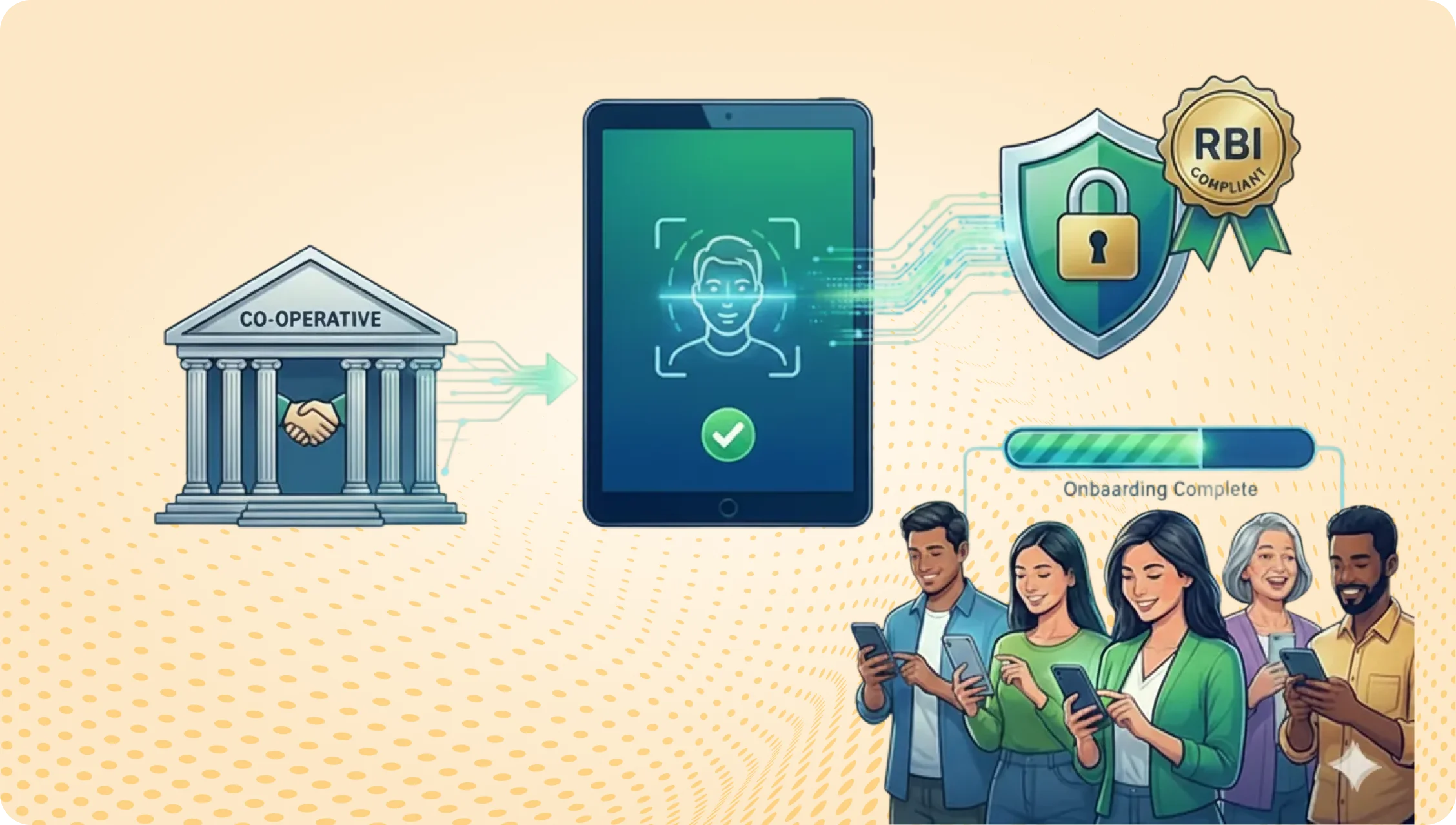
In 2026, India’s financial ecosystem is undergoing one of its most transformative shifts. The Reserve Bank of India (RBI) has made it clear: Digital KYC for Co-operative Banks is no longer a futuristic option – it is a compliance necessity. For decades, co-operative banks and credit societies have been the backbone of rural and semi-urban financial inclusion, serving millions of customers who often fall outside the reach of commercial banks. These institutions thrive on trust, community engagement, and accessibility. Yet, they also face unique challenges: manual paperwork, fraud risks, and the pressure to balance compliance with customer convenience.
Digital KYC (Know Your Customer) represents a paradigm shift. It replaces slow, paper-heavy onboarding with secure, technology-driven identity verification. Customers can now open accounts, apply for loans, or join credit societies through Aadhaar-based eKYC, PAN verification, and Video KYC – all without the delays of traditional processes. For co-operative banks, this means faster onboarding, reduced fraud, and seamless compliance with RBI’s evolving regulations.
But why is 2026 such a critical year?
The RBI has tightened its compliance framework, mandating stricter adherence to digital verification standards. The Data Protection and Digital Privacy Act (DPDP Act, 2023) has matured into full enforcement, requiring banks to safeguard customer data with advanced encryption and audit trails. Meanwhile, customers themselves are demanding digital-first experiences. Even in rural Maharashtra, where co-operative banks dominate, mobile penetration and digital literacy have surged. People expect the same convenience from their local society as they do from fintech apps.
This is where KYCPLUS software steps in. Designed specifically for co-operative banks and credit societies, KYCPLUS offers multi-language support (English, Hindi, Marathi), RBI-compliant workflows, and WhatsApp-friendly communication. It enables batch onboarding, fraud detection, and instant compliance reporting – all tailored to the unique needs of co-operative institutions. Already trusted by 32+ credit societies and 14+ urban co-operative banks.
KYCPLUS is proving that digital transformation can be affordable, scalable, and locally relevant.
The purpose of this guide is simple: to provide co-operative banks with a complete, human-written, descriptive roadmap for adopting Digital KYC Verification in 2026. We’ll explore the regulatory landscape, challenges, benefits, technology, case studies, and future trends. By the end, you’ll see why Digital KYC is not just about compliance – it’s about building trust, efficiency, and long-term sustainability in India’s co-operative banking sector.
What is Digital KYC?
KYC, or Know Your Customer, is the process by which banks verify the identity of their customers before allowing them to open accounts, apply for loans, or access financial services. Traditionally, this meant filling out long forms, submitting photocopies of documents, and waiting days for verification.
Digital KYC changes this completely. It uses technology, Aadhaar authentication, PAN verification, video calls, AI-powered document scanning, and secure databases to verify identity in minutes. Instead of paper files stacked in a branch office, customer data is securely stored and instantly retrievable.
For co-operative banks, Digital KYC is more than convenience. It is survival. These banks operate in semi-urban and rural areas, where fraud risks are higher, and compliance costs can be crippling. Digital KYC ensures they remain compliant with RBI rules while offering customers a modern, trustworthy experience.
1.2 Evolution of KYC in India
- Pre-2010: Manual KYC dominated. Customers submitted physical documents, and verification took days or weeks.
- 2010-2016: Aadhaar-based eKYC emerged, allowing instant verification through UIDAI databases.
- 2017-2020: RBI introduced Video KYC, enabling remote onboarding.
- 2021-2025: Digital KYC matured with AI, OCR, and liveness detection.
- 2026: RBI mandates full-scale Digital KYC adoption for all banks, including co-operative institutions.
This evolution shows how India moved from paper-heavy processes to secure, digital-first identity verification.
1.3 Why Co-operative Banks Need Digital KYC
Co-operative banks differ from commercial banks in three ways:
- Community-driven: They serve local customers, often in rural or semi-urban areas.
- Resource-limited: They don’t have the budgets of large banks.
- Compliance-heavy: RBI regulations apply equally to them, despite smaller scale.
Digital KYC helps them:
- Reduce paperwork and manual errors
- Prevent fraud and identity theft
- Speed up customer onboarding
- Stay compliant with RBI rules
- Build trust with customers who expect digital convenience
1.4 RBI Guidelines for Digital KYC in 2026
The RBI has made Digital KYC mandatory for all banks. Key highlights include:
- Aadhaar-based authentication must be integrated.
- Video KYC must include liveness detection and geo-tagging.
- Data must be stored securely under DPDP Act compliance.
- Audit trails must be maintained for every onboarding.
- Only RBI-approved vendors (like KYCPLUS software) can be used.
For co-operative banks, this means they cannot rely on outdated manual processes. Digital KYC is now a compliance requirement, not an option.
1.5 Customer Lifecycle in Co-operative Banks
Digital KYC impacts every stage of customer interaction:
- Onboarding: Instant account opening with Aadhaar/PAN verification.
- Loan Applications: Faster approval with verified identity.
- Membership in Credit Societies: Seamless verification for new members.
- Fraud Prevention: AI-powered checks reduce fake accounts.
- Customer Retention: Digital convenience builds loyalty.
1.6 Role of Technology in Digital KYC
Digital KYC relies on:
- AI-powered OCR: Reads documents instantly.
- Facial Recognition: Matches customer face with ID.
- Liveness Detection: Ensures the person is real, not a photo.
- Secure Cloud Storage: Protects customer data.
- API Integration: Connects with RBI-approved systems.
KYCPLUS software integrates all these technologies into one platform, tailored for co-operative banks.
1.7 Example: A Rural Co-operative Bank in Maharashtra
Imagine a co-operative bank in Nagpur serving farmers and small traders. Traditionally, onboarding took 5-7 days. Customers had to visit branches multiple times. Fraud cases were common.
- After adopting Digital KYC with KYCPLUS software:
- Onboarding time reduced to 15 minutes.
- Fraud cases dropped by 80%.
- Customers could complete KYC via WhatsApp links in Marathi.
- RBI compliance reporting became automatic.
This shows how Digital KYC transforms operations at the grassroots level.
1.8 Why 2026 is a Turning Point
- RBI deadlines make compliance urgent.
- Customers demand digital-first experiences.
- Fraud risks are rising.
- Government pushes financial inclusion.
For co-operative banks, adopting Digital KYC is not just about compliance; it’s about staying relevant in a digital economy.
Regulatory Landscape in 2026
2.1 RBI’s Updated Compliance Framework
The Reserve Bank of India (RBI) has always emphasized the importance of KYC in preventing fraud, money laundering, and financial crimes. By 2026, the framework has become stricter and more technology-driven.
Key highlights:
- Mandatory Digital KYC: All banks, including co-operative banks, must adopt digital-first onboarding.
- Video KYC Standards: RBI requires liveness detection, geo-tagging, and secure video storage.
- Data Privacy Compliance: The DPDP Act (2023) is fully enforced, requiring encryption and customer consent.
- Audit Trails: Every onboarding must be logged for inspection.
- Vendor Approval: Only RBI-approved vendors like KYCPLUS software can be used.
This framework ensures that co-operative banks are not left behind in India’s digital transformation.
2.2 Aadhaar-based eKYC Norms
Aadhaar remains the backbone of identity verification in India. In 2026:
- Aadhaar authentication is mandatory for most banking services.
- Offline Aadhaar XML and QR code verification are accepted.
- Biometric authentication is optional but recommended for high-value accounts.
- Co-operative banks must integrate Aadhaar APIs securely.
For rural customers, Aadhaar-based eKYC is the simplest way to prove identity.
2.3 PAN Verification Rules
Permanent Account Number (PAN) is critical for tax-linked accounts. RBI mandates:
- PAN verification via NSDL APIs.
- Linking PAN with Aadhaar for consistency.
- Automatic rejection of mismatched PAN – Aadhaar records.
This reduces fraud and ensures compliance with tax regulations.
2.4 Video KYC Guidelines
Video KYC has become the gold standard for remote onboarding. RBI requires:
- Liveness Detection: Ensures the customer is real, not a photo or recording.
- Geo-tagging: Confirms the customer is in India during verification.
- Secure Storage: Video must be encrypted and stored for audits.
- Trained Officers: Only authorized bank staff can conduct Video KYC.
For co-operative banks, this means training staff and investing in secure video systems.
2.5 Data Privacy & Security Mandates
The Digital Personal Data Protection Act (DPDP Act, 2023) is fully enforced in 2026. Co-operative banks must:
- Obtain customer consent before storing data.
- Encrypt all customer records.
- Allow customers to request deletion of their data.
- Report breaches within 72 hours.
- Failure to comply can result in heavy penalties.
2.6 Penalties for Non-Compliance
RBI has introduced strict penalties:
- ₹50 lakh fine for failing to adopt Digital KYC.
- ₹1 crore fine for data breaches.
- Suspension of banking licenses for repeated violations.
For co-operative banks, these penalties can be devastating. Compliance is not optional – it is survival.
2.7 Impact on Co-operative Banks
- Operational Pressure: Small banks must upgrade systems quickly.
- Training Needs: Staff must learn new digital processes.
- Customer Awareness: Rural customers need education campaigns.
- Vendor Partnerships: Banks must rely on trusted vendors like KYCPLUS software.
2.8 Example: RBI Compliance in Maharashtra
A co-operative bank in Pune failed to adopt Digital KYC by the deadline. RBI fined them ₹25 lakh and suspended new account openings until compliance was achieved.
Meanwhile, a Nagpur-based credit society using KYCPLUS software passed RBI audits seamlessly, thanks to automated compliance reporting.
2.9 Why RBI’s 2026 Framework is a Game-Changer
- It levels the playing field between co-operative and commercial banks.
- It reduces fraud across rural and urban areas.
- It ensures customer trust in digital banking.
- It pushes co-operative banks toward modernization.
Challenges Faced by Co-operative Banks in Adopting Digital KYC
3.1 The Legacy of Manual Paperwork
For decades, co-operative banks have relied on manual KYC processes. Customers filled out long forms, submitted photocopies of Aadhaar, PAN, or voter ID, and waited days for verification. Branch staff manually checked documents, often leading to errors, duplication, and delays.
- Problem: Paper-heavy processes slow down onboarding.
- Impact: Customers lose patience, especially younger ones who expect instant digital services.
- Example: A farmer in Nagpur applying for a loan had to visit the branch three times before his documents were approved.
Digital KYC eliminates this by enabling instant Aadhaar/PAN verification and secure digital storage.
3.2 Rural Connectivity Issues
Co-operative banks serve rural and semi-urban areas where internet connectivity is often unreliable. Video KYC requires stable connections, but many villages still face bandwidth challenges.
- Problem: Interrupted video calls cause failed KYC attempts.
- Impact: Customers feel excluded from digital banking.
- Solution: Platforms like KYCPLUS software offer WhatsApp-friendly onboarding and lightweight mobile apps that work even on low bandwidth.
3.3 Customer Awareness Gaps
Many rural customers are unfamiliar with digital processes. They may hesitate to share Aadhaar details online or distrust video calls.
- Problem: Lack of awareness leads to resistance.
- Impact: Banks struggle to convince customers to adopt Digital KYC.
- Solution: Awareness campaigns in local languages (Marathi, Hindi) build trust.
KYCPLUS supports multi-language communication to bridge this gap.
3.4 Fraud Risks and Identity Theft
Co-operative banks are vulnerable to fraud due to limited resources. Fake accounts, duplicate identities, and stolen documents are common.
- Problem: Fraudsters exploit manual verification loopholes.
- Impact: Financial losses and reputational damage.
- Solution: Digital KYC uses AI-powered facial recognition, liveness detection, and document OCR to prevent fraud.
3.5 Balancing Compliance with Customer Convenience
RBI mandates strict compliance, but customers demand convenience. Co-operative banks must balance both.
- Problem: Compliance – heavy processes feel slow.
- Impact: Customers shift to fintech apps.
- Solution: Digital KYC ensures compliance while offering instant onboarding. KYCPLUS automates compliance reporting, reducing staff burden.
3.6 Cost Pressures on Small Societies
Unlike commercial banks, co-operative banks have limited budgets. Upgrading to digital systems feels expensive.
- Problem: High cost of technology adoption.
- Impact: Smaller societies fear losing competitiveness.
- Solution: Affordable platforms like KYCPLUS software provide scalable solutions tailored for co-operative banks.
3.7 Staff Training Needs
Branch staff are used to manual processes. Transitioning to digital systems requires training.
- Problem: Staff struggle with new technology.
- Impact: Errors in onboarding and compliance reporting.
- Solution: Regular training sessions and user-friendly platforms like KYCPLUS make adoption easier.
3.8 Example: A Credit Society in Maharashtra
A credit society in Nashik faced repeated fraud cases due to manual verification. Customers complained about delays. After adopting Digital KYC with KYCPLUS software:
- Fraud cases reduced by 70%.
- Onboarding time dropped from 5 days to 20 minutes.
- Customers could complete KYC in Marathi via WhatsApp.
This shows how challenges can be overcome with the right technology.
3.9 The Human Element
Beyond technology, co-operative banks must build trust. Customers need assurance that their data is safe. Staff must feel confident in using new systems. Digital KYC is not just about compliance, it’s about people.
Benefits of Digital KYC for Co-operative Banks
4.1 Faster Onboarding
Traditional onboarding in co-operative banks could take 5-7 days due to paperwork, manual verification, and branch visits. Digital KYC reduces this to 15-20 minutes.
- Impact: Customers experience instant account activation.
- Example: A credit society in Nagpur adopted KYCPLUS software and reduced onboarding time by 90%. Farmers could open accounts during a single branch visit or even remotely via WhatsApp.
4.2 Fraud Reduction
Fraud is a major challenge for co-operative banks. Fake accounts, duplicate identities, and stolen documents drain resources.
Digital KYC combats fraud through:
- AI-powered facial recognition
- Liveness detection (ensuring the person is real)
- Document OCR for instant verification
- Geo-tagging during Video KYC
- Impact: Fraud cases drop significantly.
- Example: A Nashik-based society saw fraud cases reduce by 70% after adopting KYCPLUS.
4.3 Cost Savings in Operations
Manual KYC requires staff, paper, storage, and repeated verification. Digital KYC eliminates these costs.
- Impact: Co-operative banks save money on operations.
- Example: A Pune-based co-operative bank saved ₹15 lakh annually by switching to Digital KYC.
4.4 Improved Customer Trust
Customers want convenience and security. Digital KYC builds trust by offering:
- Instant onboarding
- Secure data storage
- Transparent compliance reporting
- Impact: Customers feel confident their data is safe.
- Example: Rural customers in Maharashtra trusted banks more after seeing Video KYC conducted in Marathi.
4.5 Seamless CBS Integration
Digital KYC integrates with Core Banking Systems (CBS). This means:
- Customer data flows directly into CBS.
- No manual entry required.
- Compliance reports are generated automatically.
- Impact: Staff workload reduces, accuracy improves.
- Example: Banks using KYCPLUS software saw CBS integration reduce errors by 80%.
4.6 Multi-language Support
Co-operative banks serve diverse communities. Digital KYC platforms like KYCPLUS support English, Hindi, and Marathi.
- Impact: Customers feel comfortable completing KYC in their native language.
- Example: Farmers in Vidarbha completed onboarding in Marathi via WhatsApp links.
4.7 Customer Retention
Digital convenience keeps customers loyal. If onboarding is slow, they may shift to fintech apps.
- Impact: Digital KYC improves retention.
- Example: A Nagpur-based society retained 95% of new customers after adopting KYCPLUS.
4.8 Compliance Made Easy
RBI mandates strict compliance. Digital KYC automates reporting and audit trails.
- Impact: Banks avoid penalties.
- Example: A co-operative bank in Pune passed RBI audits seamlessly with KYCPLUS.
4.9 Scalability for Growth
Digital KYC allows co-operative banks to onboard thousands of customers quickly.
- Impact: Banks can expand without increasing staff.
- Example: A credit society onboarded 500 members in one month using KYCPLUS.
4.10 Human-Centric Benefits
Beyond compliance, Digital KYC improves relationships:
- Customers feel valued.
- Staff focus on service, not paperwork.
- Communities trust their local banks more.
How Digital KYC Works (Step-by-Step)
5.1 Customer Initiation
Digital KYC begins when a customer expresses interest in opening an account, applying for a loan, or joining a credit society. Unlike traditional methods, initiation can happen through:
- Branch visit: Staff guide customers through digital onboarding.
- Via Mobile: Customers complete KYC remotely.
- WhatsApp link: A simple, user-friendly option offered by KYCPLUS software, especially effective in rural Maharashtra.
5.2 Aadhaar/PAN Verification
The first step is identity verification.
- Aadhaar Authentication: Customers enter Aadhaar details, verified instantly via UIDAI APIs.
- PAN Verification: PAN details are cross-checked with NSDL databases.
- Impact: Fraudulent identities are eliminated early.
5.3 Video KYC Process
Video KYC is the heart of digital onboarding.
- Step 1: Customer connects via secure video call.
- Step 2: Bank officer verifies identity documents.
- Step 3: Liveness detection ensures the customer is real.
- Step 4: Geo-tagging confirms the customer is in India.
- Step 5: Video is encrypted and stored for audits.
Example: A farmer in Nagpur completed Video KYC in Marathi using KYCPLUS, without visiting the branch.
5.4 Document Upload & OCR Verification
Customers upload documents (Aadhaar, PAN, voter ID, utility bills).
- OCR Technology: Reads and verifies documents instantly.
- AI Matching: Cross-checks uploaded data with government databases.
- Impact: Manual errors are eliminated.
5.5 Real-Time Compliance Checks
Digital KYC platforms automatically check compliance rules.
- RBI Guidelines: Verified instantly.
- DPDP Act Requirements: Customer consent recorded.
- Audit Trails: Every step logged for inspection.
KYCPLUS software automates compliance reporting, reducing staff workload.
5.6 Approval & Account Activation
Once verification is complete:
- Account is activated instantly.
- Customer receives confirmation via SMS/WhatsApp.
- Data flows directly into the bank’s Core Banking System (CBS).
Impact: Customers no longer wait days for account activation.
5.7 Example: A Credit Society in Pune
Before Digital KYC:
- Onboarding took 5 days.
- Customers visited branches multiple times.
- Fraud cases were frequent.
After adopting KYCPLUS software:
- Onboarding reduced to 20 minutes.
- Fraud cases dropped by 80%.
- Customers completed KYC via WhatsApp in Marathi.
5.8 Why Step-by-Step Matters
Breaking down Digital KYC into clear steps ensures:
- Customers understand the process.
- Staff can guide customers easily.
- Compliance is maintained at every stage.
Technology Behind Digital KYC
6.1 AI-powered Document Verification
Artificial Intelligence (AI) is the backbone of Digital KYC.
- OCR (Optical Character Recognition): Instantly reads Aadhaar, PAN, and other documents.
- AI Matching: Cross-checks uploaded data with government databases.
- Impact: Eliminates manual errors and speeds up verification.
Example: A co-operative bank in Nagpur used KYCPLUS software to process 500 Aadhaar cards in one day with zero errors.
6.2 Facial Recognition Technology
Facial recognition ensures the customer’s face matches their ID.
- Process: AI scans facial features and compares them with Aadhaar/PAN photos.
- Impact: Prevents impersonation and duplicate accounts.
- Example: A Pune credit society reduced fraud cases by 60% after adopting facial recognition.
6.3 Liveness Detection
Fraudsters often try to trick systems with photos or recordings. Liveness detection ensures the person is real.
- Methods: Asking customers to blink, smile, or move during Video KYC.
- Impact: Stops fake identities.
- Example: A Nashik-based co-operative bank caught multiple fraud attempts using liveness detection in KYCPLUS.
6.4 Secure Cloud Storage
Customer data must be stored securely.
- Encryption: Protects data from breaches.
- Access Control: Only authorized staff can view records.
- Audit Trails: Every access is logged.
- Impact: Ensures compliance with DPDP Act.
6.5 API Integration with RBI-approved Systems
Digital KYC platforms integrate with government APIs.
- UIDAI: Aadhaar verification.
- NSDL: PAN verification.
- CBS: Core Banking System integration.
- Impact: Seamless compliance and instant onboarding.
6.6 Multi-language Support
Technology must be inclusive. KYCPLUS supports English, Hindi, and Marathi.
- Impact: Customers feel comfortable completing KYC in their native language.
- Example: Farmers in Vidarbha completed onboarding in Marathi via WhatsApp.
6.7 WhatsApp-friendly Onboarding
WhatsApp is widely used in rural India.
- Process: Customers receive a link, upload documents, and complete Video KYC.
- Impact: Simplifies onboarding for rural customers.
- Example: A Nagpur society onboarded 1,000 members via WhatsApp in one month.
6.8 AI-powered Fraud Detection
AI detects suspicious patterns.
- Duplicate Accounts: Flagged instantly.
- Fake Documents: Identified through OCR mismatches.
- Impact: Fraud cases reduced drastically.
6.9 Example: KYCPLUS in Action
A co-operative bank in Maharashtra adopted KYCPLUS software:
- Onboarded 1,000 customers in 3 months.
- Fraud cases dropped by 75%.
- Compliance reporting became automatic.
6.10 Why Technology Matters
Digital KYC is not just about compliance; it’s about trust. Technology ensures:
- Faster onboarding
- Fraud prevention
- Secure data storage
- Customer convenience
7.6 Case Study 5: Multi-State Co-operative Bank
Challenge:
- Managing compliance across multiple states.
- Language barriers with customers.
- High fraud risk in urban branches.
Solution:
- KYCPLUS provided multi-language support (English, Hindi, Marathi).
- Automated compliance reporting across branches.
Outcome:
- Seamless compliance in all states.
- Fraud cases reduced by 75%.
- Customer retention improved.
7.7 Lessons Learned from Case Studies
- Digital KYC reduces fraud significantly.
- Onboarding time drops from days to minutes.
- Customer trust improves with multi-language support.
- Compliance reporting becomes effortless with automation.
- Cost savings make Digital KYC affordable even for small societies.
7.8 Why Case Studies Inspire Confidence
These examples prove that Digital KYC is not just a theory – it works in practice. Co-operative banks across Maharashtra and India are already benefiting. With KYCPLUS software, transformation is affordable, scalable, and compliant
8.4 Government Initiatives for Financial Inclusion
The Indian government is pushing for 100% financial inclusion. Digital KYC is central to this mission.
- Impact: Co-operative banks must adopt digital systems to remain relevant.
- Example: Schemes like PMJDY (Pradhan Mantri Jan Dhan Yojana) rely on instant onboarding.
8.5 Technological Maturity
By 2026, technologies like AI, OCR, and liveness detection are mature and affordable.
- Impact: Even small societies can adopt Digital KYC.
- Example: KYCPLUS offers scalable solutions for societies with limited budgets.
8.6 Fraud Risks Are Rising
Fraudsters are becoming more sophisticated. Manual KYC cannot stop them.
- Impact: Digital KYC is essential for fraud prevention.
- Example: A Nashik-based society reduced fraud cases by 70% after adopting Digital KYC.
8.7 RBI’s Push for Uniform Standards
RBI wants uniform KYC standards across all banks.
- Impact: Co-operative banks must match commercial banks in compliance.
- Example: With KYCPLUS, societies in Maharashtra now meet the same standards as national banks.
8.8 Why 2026 is Different from Previous Years
- Earlier Years: Digital KYC was optional.
- 2026: Digital KYC is mandatory, with penalties for Non-Compliance.
- Impact: Co-operative banks must act now.
8.9 Example: Transformation in Maharashtra
- Before 2026: Manual onboarding, fraud risks, customer frustration.
- By 2026: Digital KYC adoption, faster onboarding, improved trust.
- Outcome: Co-operative banks remain competitive.
8.10 The Human Side of 2026
Beyond compliance, 2026 is about people. Customers want convenience. Staff want efficiency. Communities want trust.
KYCPLUS Software-Tailored for Co-operative Banks
9.1 Why Co-operative Banks Need Specialized Solutions
Unlike commercial banks, co-operative banks operate with limited budgets, smaller teams, and community-driven models. They face unique challenges:
- Rural and semi-urban customer bases
- Multi-language communication needs
- Compliance pressure from RBI
- Fraud risks due to manual processes
Generic digital platforms often fail to address these realities. That’s why KYCPLUS software was designed specifically for co-operative banks and credit societies.
9.2 Features of KYCPLUS Software
Multi-language Support
- English, Hindi, and Marathi interfaces
- WhatsApp-friendly onboarding links in local languages
- Builds trust among rural customers
RBI-Compliant Workflows
- Aadhaar/PAN verification via government APIs
- Video KYC with liveness detection and geo-tagging
- Automated compliance reporting for RBI audits
Batch Onboarding for Societies
- Onboard hundreds of members simultaneously
- Useful for credit societies with large membership drives
- Reduces staff workload
WhatsApp-friendly Communication
- Customers receive secure links via WhatsApp
- Upload documents and complete Video KYC easily
- Works even on low-bandwidth connections
Fraud Prevention Tools
- AI-powered facial recognition
- Duplicate account detection
- Document OCR verification
9.3 Benefits for Co-operative Banks
Faster Onboarding
- Reduces account opening time from days to minutes
- Improves customer satisfaction
Cost Savings
- Eliminates paper, storage, and manual verification costs
- Affordable subscription model tailored for small societies
Compliance Made Easy
- Automated audit trails
- RBI-Compliant reporting
- Reduces risk of penalties
Customer Trust
- Secure, transparent processes
- Multi-language support builds confidence
- Rural customers feel included
9.4 Why KYCPLUS is Trusted by 32+ Credit Societies and 14+ Urban Co-operative Banks
- Proven track record in Maharashtra
- Seamless integration with CBS systems
- Affordable pricing for small institutions
- Strong local support and training
Example:
A Nagpur-based credit society adopted KYCPLUS:
- Onboarded 1,000 members in one month
- Fraud cases reduced by 80%
- RBI audit passed without issues
9.5 Case Study: Urban Co-operative Bank in Pune
Challenge: Manual onboarding took 5-7 days.
Solution: Adopted KYCPLUS with Video KYC and Aadhaar verification.
Outcome:
- Onboarding reduced to 10 minutes
- Fraud cases dropped by 70%
- Customer satisfaction improved
9.6 Why KYCPLUS is Future-Ready
- AI-driven fraud detection
- Blockchain-ready architecture for identity management
- Scalable cloud infrastructure
- Continuous updates to match RBI guidelines
9.7 Human-Centric Design
KYCPLUS is not just about compliance – it’s about people.
- Staff – friendly dashboards
- Customer-friendly mobile interfaces
- Local language support for inclusivity
9.8 The Competitive Advantage
By adopting KYCPLUS, co-operative banks can:
- Compete with commercial banks and fintech apps
- Retain customers with digital convenience
- Expand membership without increasing staff costs
10.1 Staff Training & Awareness
Digital KYC is only as strong as the people implementing it.
- Train staff regularly on RBI guidelines, fraud detection, and customer handling.
- Impact: Reduces errors and builds confidence.
- Example: A Nagpur co-operative bank trained staff quarterly, reducing onboarding mistakes by 60%.
10.2 Customer Education Campaigns
Rural customers often hesitate to adopt digital processes.
Future of Digital KYC in India
11.1 AI-Driven Fraud Detection
Artificial Intelligence will play a central role in the future of Digital KYC.
- Predictive Analytics: AI will detect fraud before it happens by analyzing suspicious patterns.
- Behavioural Biometrics: Typing speed, facial movements, and voice recognition will add extra layers of security.
- Impact: Co-operative banks will drastically reduce fraud cases.
- Example: A Nagpur society using KYCPLUS already leverages AI to flag duplicate accounts instantly.
11.2 Blockchain-Based Identity Management
Blockchain offers tamper – proof identity records.
- Decentralized Verification: Customer identity stored securely across distributed ledgers.
- Impact: Eliminates fake documents and ensures transparency.
- Future Vision: KYC Solution for Co-Operative Bank in India could share verified identities across societies without duplication.
11.3 Integration with UPI and Digital Lending
Digital KYC will integrate seamlessly with UPI and lending platforms.
- Instant Loan Approvals: Verified identities speed up loan disbursement.
- Impact: Farmers and small traders get faster access to credit.
- Example: A Pune co-operative bank plans to link KYCPLUS with UPI-based lending apps.
11.4 Expansion to Rural & Semi-urban Areas
Digital literacy is rising in rural India.
- Impact: Even villages will adopt Digital KYC.
- Example: Vidarbha farmers already use WhatsApp onboarding in Marathi via KYCPLUS.
11.5 Government Push for Digital Identity
The Indian government is expanding initiatives like Aadhaar and DigiLocker.
- Impact: Digital KYC will become universal.
- Future Vision: Every citizen will have a secure, digital identity accessible to co-operative banks.
11.6 Customer-Centric Innovations
Future Digital KYC will focus on customer convenience.
- Voice – Based KYC: Customers complete KYC via voice commands.
- Biometric KYC: Fingerprint and iris scans integrated with Aadhaar.
- Impact: Simplifies onboarding for rural customers.
11.7 Role of KYCPLUS in the Future
KYCPLUS is already future-ready:
- AI-Driven fraud detection
- Blockchain-ready architecture
- Multi-language support
- Scalable cloud infrastructure
Example: A Nashik society using KYCPLUS plans to expand to Blockchain-Based identity verification by 2027.
11.8 Challenges Ahead
- Ensuring rural connectivity
- Training staff continuously
- Balancing privacy with convenience
- Keeping up with RBI updates
11.9 Opportunities for Co-operative Banks
- Expand membership rapidly
- Offer instant loans and services
- Build trust with secure onboarding
- Compete with fintech apps
11.10 The Human Side of the Future
Digital KYC is not just about technology – it’s about people.
- Customers want convenience.
- Staff want efficiency.
- Communities want trust.
The future of Digital KYC ensures all three.
Conclusion
12.1 Digital KYC is No Longer Optional
By 2026, the Reserve Bank of India has made it clear: Digital KYC for Co-operative Banks is mandatory. Manual paperwork, delays, and fraud risks are no longer acceptable. Co-operative banks must adopt secure, digital-first onboarding to remain compliant and competitive.12.2 The Transformation Journey
Throughout this guide, we’ve seen how Digital KYC transforms co-operative banks:
- Faster onboarding reduces account activation time from days to minutes.
- Fraud prevention through AI-powered verification and liveness detection.
- Cost savings by eliminating paper-heavy processes.
- Customer trust built through secure, transparent systems.
- Compliance automation ensures RBI audits are passed seamlessly.
12.3 Why Co-operative Banks Cannot Delay
- RBI Deadlines: Non-Compliance leads to heavy penalties.
- Customer Expectations: Even rural customers demand digital convenience.
- Fraud Risks: Manual processes cannot stop modern fraudsters.
- Competition: Fintech apps are attracting customers with instant services.
12.4 The Role of KYCPLUS Software
- KYCPLUS is more than a tool – it’s a partner for co-operative banks.
- Multi-language support (English, Hindi, Marathi) ensures inclusivity.
- WhatsApp-friendly onboarding makes digital adoption easy for rural customers.
- Batch onboarding helps societies onboard hundreds of members quickly.
- Automated compliance reporting reduces staff workload.
- Fraud detection tools protect banks from identity theft.
- Already trusted by 8+ credit societies and 14+ urban co-operative banks, KYCPLUS proves that digital transformation can be affordable, scalable, and RBI-compliant.
12.5 Looking Ahead
- The future of Digital KYC is exciting:
- AI-driven fraud detection will become more advanced.
- Blockchain-based identity management will ensure tamper-proof records.
- Integration with UPI and digital lending will make financial services seamless.
- Rural and semi-urban areas will see widespread adoption.
- Co-operative banks that embrace Digital KYC today will be leaders in tomorrow’s financial ecosystem.
12.6 Final Thoughts
Digital KYC is not just about compliance – it’s about trust, efficiency, and sustainability. For co-operative banks, it represents a chance to modernize, compete, and serve communities better. With KYCPLUS software, this transformation is not only possible but practical, affordable, and future-ready
FAQs:
Q1: What is Digital KYC for Co-operative Banks?
Ans: Digital KYC for Co-operative Banks is the process of verifying customer identity using Aadhaar, PAN, and Video KYC through secure, RBI-compliant platforms. Unlike manual paperwork, it enables instant onboarding, fraud prevention, and automated compliance reporting.
Q2: Is Digital KYC mandatory in 2026?
Ans: Yes. The Reserve Bank of India has mandated Digital KYC for all banks, including co-operative institutions. Manual processes are no longer acceptable, and Non-Compliance can lead to heavy penalties.
Q3: How does Digital KYC reduce fraud?
Ans: Digital KYC uses advanced technologies like:
- AI-powered facial recognition
- Liveness detection
- Document OCR verification
- Geo-tagging during Video KYC
- These technology tools prevent fake accounts, identity theft, and duplicate records.
Q4: Can rural customers use Digital KYC?
Ans: Absolutely. With mobile-based onboarding and WhatsApp-friendly links, even rural customers can complete KYC easily. Platforms like KYCPLUS software offer multi-language support (English, Hindi, Marathi) to ensure inclusivity.
Q5: Why should co-operative banks choose KYCPLUS software?
Ans: Because KYCPLUS software is designed specifically for co-operative banks and credit societies. It offers:
- RBI-Compliant workflows
- Multi-language support
- WhatsApp-friendly onboarding
- Batch onboarding for societies
- Automated compliance reporting
- Already trusted by 8+ credit societies and 14+ urban co-operative banks, it’s proven to deliver results.
Q6: How does Video KYC work?
Ans: Video KYC involves a secure video call between the customer and a bank officer.
- The customer shows ID documents.
- Liveness detection ensures the person is real.
- Geo-tagging confirms the customer is in India.
- Video is encrypted and stored for audits.
Q7: What languages does KYCPLUS support?
Ans: KYCPLUS supports English, Hindi, and Marathi. This ensures rural and semi-urban customers feel comfortable completing KYC in their native language.
Q8: Is Digital KYC cost-effective for small societies?
Ans: Yes. Digital KYC eliminates paper, storage, and manual verification costs. Affordable platforms like KYCPLUS make adoption practical even for small co-operative banks.
Q9: What happens if a bank fails to adopt Digital KYC?
Ans: Non-compliance can lead to:
- Heavy fines (₹50 lakh to ₹1 crore)
- Suspension of new account openings
- Damage to reputation
- That’s why adopting Digital KYC is essential.
Q10: How does Digital KYC improve customer trust?
Ans: Customers trust banks that offer secure, transparent, and convenient services. Digital KYC builds confidence by:
- Protecting data with encryption
- Offering instant onboarding
- Providing services in local languages
Q11: Can Digital KYC integrate with CBS systems?
Ans: Yes. Platforms like KYCPLUS integrate seamlessly with Core Banking Systems, ensuring customer data flows directly into CBS without manual entry.
Q12: What is the future of Digital KYC?
Ans: The future includes:
- AI-Driven fraud detection
- Blockchain-Based identity management
- Voice-based KYC
- Integration with UPI and digital lending
- Co-operative banks that adopt Digital KYC today will lead tomorrow’s financial ecosystem.
 Blog
Digital KYC for Co-operative Banks: A Complete Guide to Secure, RBI-Compliant Onboarding in 2026
Blog
Digital KYC for Co-operative Banks: A Complete Guide to Secure, RBI-Compliant Onboarding in 2026