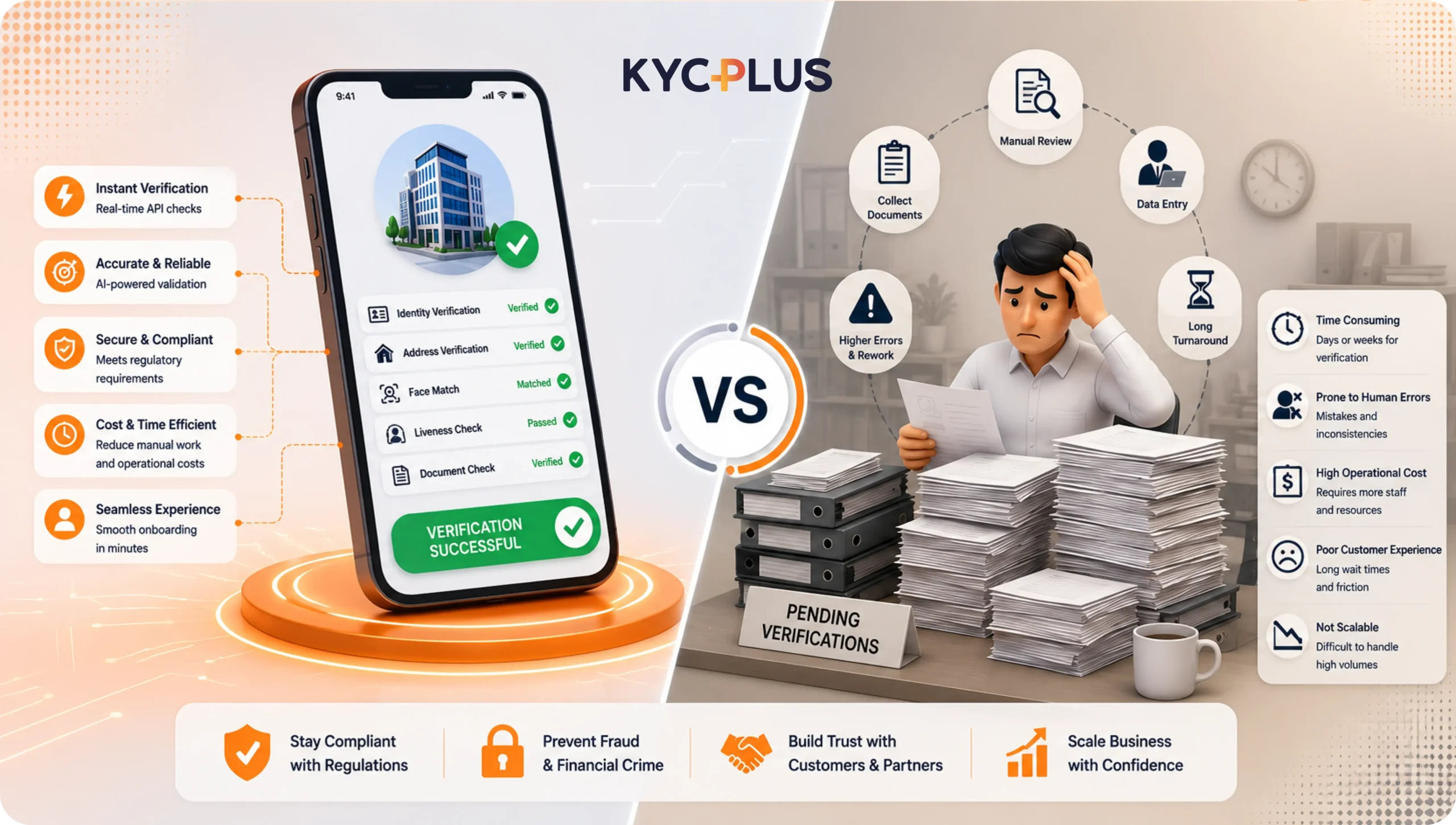
Customer onboarding has changed dramatically over the past decade. Earlier, opening a bank account, applying for a loan, purchasing insurance, or registering for a financial service often meant visiting a branch, filling out paper forms, submitting photocopies of identity documents, and waiting several days for verification. Today, businesses use a KYC Verification API to automate identity verification and significantly reduce onboarding time. While the traditional process worked for many years, it is no longer suitable for today’s digital-first world, where customers expect instant access to services and businesses compete on speed and convenience. The rapid growth of digital banking, fintech platforms, online lending, e-commerce, and mobile applications has fundamentally changed customer expectations. As a result, organizations increasingly integrate a KYC Verification API into their digital onboarding workflows, enabling customers to complete the entire verification process securely from their smartphone or laptop without visiting a physical office.
This shift has encouraged organizations to modernize their identity verification processes through automation and digital technologies. At the center of this transformation is the KYC Verification API, a technology that enables businesses to automate customer verification directly within their applications. Instead of relying on manual document reviews and physical verification, businesses can instantly verify customer information, authenticate identity documents, perform face matching, conduct liveness checks, and complete compliance workflows in real time.
Smaller businesses, traditional financial institutions, and organizations with legacy systems often believe manual verification provides greater control or is easier to manage. However, as customer volumes grow and compliance requirements become stricter, manual processes frequently become slower, more expensive, and more prone to human error.
Choosing between a KYC Verification API and manual verification is no longer just an operational decision- it is a strategic business decision. The right approach can improve customer experience, reduce onboarding costs, strengthen regulatory compliance, and help businesses scale efficiently.
In this comprehensive guide, we’ll compare KYC Verification API vs Manual Verification, explain how each method works, examine their advantages and limitations, discuss regulatory considerations, and help you determine which solution best fits your business needs.
Know Your Customer (KYC) Verification is the process of confirming a customer’s identity before providing financial products or regulated services. It is one of the most important compliance requirements for banks, NBFCs, insurance companies, fintech platforms, securities firms, payment service providers, and other regulated businesses.
The primary objective of KYC is to ensure that organizations know exactly who their customers are. This helps prevent financial crimes such as money laundering, identity theft, terrorist financing, fraud, and other illegal activities.
KYC is not simply about collecting identity documents. It is a structured process that combines identity verification, document validation, customer due diligence, and risk assessment to establish trust between a business and its customers.
Today, KYC has evolved from a regulatory obligation into a business enabler. Organizations that implement efficient KYC processes can onboard customers faster, reduce fraud, improve operational efficiency, and deliver a smoother digital experience.
Every organization that handles financial transactions or sensitive customer information faces potential risks. Without proper identity verification, businesses may unknowingly onboard fraudulent individuals, fake identities, or customers attempting to misuse financial systems.
Effective KYC verification helps organizations:
For customers, KYC also provides reassurance that the institution follows secure practices and takes identity protection seriously.
While regulatory compliance is a key reason for implementing KYC, the process serves several broader business objectives.
The first objective is to verify that the customer is who they claim to be by validating government-issued identity documents and personal information.
Different customers present different levels of risk. KYC enables organizations to classify customers based on factors such as occupation, geography, transaction behavior, and product usage.
Financial institutions must comply with regulations issued by authorities such as the Reserve Bank of India (RBI), Financial Action Task Force (FATF), Anti-Money Laundering (AML) frameworks, and other local regulators. Proper KYC helps organizations meet these obligations.
By verifying identities before onboarding, businesses significantly reduce the chances of identity theft, forged documents, synthetic identities, and account takeover fraud.
A secure onboarding process strengthens customer confidence and demonstrates that the organization values security and compliance.
Although KYC processes differ across industries, most verification workflows include the following components:
The organization collects basic information such as:
Identity documents are checked to confirm authenticity. Commonly verified documents include:
Modern digital systems also verify document quality, detect tampering, and validate security features.
Organizations evaluate customer risk by reviewing identity information, intended business relationship, and expected transaction patterns.
KYC does not end after onboarding. Businesses continuously monitor customer activity to identify unusual behavior, suspicious transactions, or changes in risk profile.
As technology has evolved, several different KYC methods have emerged to meet changing customer expectations and regulatory requirements.
Physical KYC is the traditional verification process in which customers visit a branch or office and submit physical copies of identity documents. Employees manually verify the information before approving the application.
Although reliable, physical KYC is often slow, resource-intensive, and inconvenient for customers.
Digital KYC allows customers to complete verification electronically by uploading identity documents and completing verification through online channels. KYC significantly reduces onboarding time while improving customer convenience.
Electronic Know Your Customer (eKYC) enables digital identity verification using government-approved electronic systems. It eliminates much of the paperwork associated with traditional onboarding.
Video KYC allows organizations to verify customer identities through secure live video interactions. During the session, customers present identity documents while trained officers confirm authenticity and perform facial verification.
Video KYC has become increasingly popular for remote onboarding.
Central Know Your Customer (CKYC) provides a centralized repository of customer KYC information. Once registered, customers can use the same KYC records across multiple participating financial institutions, reducing repetitive documentation.
Re-KYC involves periodically updating customer information to ensure records remain accurate and compliant with regulatory requirements. Many institutions now automate this process using digital workflows.
As customer onboarding shifts from physical branches to digital platforms, organizations require faster and more efficient ways to verify identities. This is where a KYC Verification API becomes essential.
A KYC Verification API is a software interface that allows applications, websites, banking platforms, and business systems to communicate directly with identity verification services. Instead of manually reviewing documents, organizations can integrate the API into their onboarding workflow to automate identity verification in real time.
For example, when a customer uploads a PAN card or Aadhaar card through a mobile application, the API securely processes the information, validates the document, performs required verification checks, and returns the results almost instantly. This dramatically reduces onboarding time while improving consistency and accuracy.
Unlike manual verification, where employees perform repetitive document reviews, API-based verification enables businesses to handle thousands of customer verifications simultaneously with minimal human intervention.
In the next section, we’ll explore how a KYC Verification API works, the technologies behind it, and why more businesses are replacing manual verification with API-driven onboarding.
A KYC Verification API acts as a bridge between your application and various identity verification services. Instead of requiring employees to manually collect, review, and validate customer information, the API automates the entire verification process in real time. Whether a customer is opening a bank account, applying for a loan, registering for a digital wallet, or purchasing an insurance policy, the API performs multiple verification checks within seconds while ensuring compliance with regulatory standards.
One of the biggest advantages of API-driven verification is that it integrates seamlessly into existing applications, websites, customer onboarding portals, and Core Banking Systems (CBS). Customers don’t have to switch between different platforms or complete lengthy paperwork. Everything happens within a single digital workflow, creating a faster and more convenient onboarding experience.
Let’s understand how a typical KYC Verification API works.
The verification journey begins when a customer initiates registration through a website, mobile application, banking portal, or financial platform.
The customer usually provides:
At this stage, the API securely captures the information and prepares it for verification.
The customer uploads one or more government-approved identity documents.
Depending on the organization’s requirements, documents may include:
Modern APIs support document uploads from:
Many solutions also guide customers to capture high-quality images by detecting blur, glare, poor lighting, or incomplete documents.
Once the document is uploaded, Optical Character Recognition (OCR) technology automatically extracts relevant information without requiring manual data entry.
OCR can identify details such as:
This significantly reduces typing errors and speeds up the onboarding process.
Advanced OCR engines can also recognize multiple document formats and languages, making verification more efficient for businesses serving diverse customer groups.
After extracting the document information, the API validates the authenticity of the submitted data.
The verification process may include:
If discrepancies are detected, the system immediately alerts the organization for further review.
Identity verification doesn’t end with document validation. Businesses also need to ensure that the person submitting the document is its rightful owner.
Most modern KYC Verification APIs include:
The customer’s live selfie is compared with the photograph available on the submitted identity document.
Advanced facial recognition algorithms analyze multiple facial characteristics to determine whether both images belong to the same individual.
Liveness detection prevents fraud attempts involving:
The system verifies that an actual person is present during verification rather than a static image or manipulated video.
These technologies significantly strengthen fraud prevention while maintaining a smooth customer experience.
Once identity verification is complete, the API performs additional compliance-related checks based on organizational and regulatory requirements.
These may include:
Automating these checks helps businesses comply with applicable regulations while reducing manual effort.
After completing all verification steps, the API generates a result.
Typical outcomes include:
The response is returned instantly to the organization’s application, allowing customer onboarding to proceed without unnecessary delays.
If manual review is required, compliance teams receive complete verification reports instead of starting the process from scratch.
A reliable KYC Verification API also maintains secure digital records for future reference and regulatory audits.
Organizations can securely store:
Maintaining digital records simplifies future investigations, internal reviews, and regulatory inspections.
Not every API offers the same capabilities. Businesses should evaluate features carefully before selecting a provider.
Automatically validates identity documents while reducing human intervention.
Extracts customer information accurately from uploaded documents.
Confirms that the individual matches the submitted identity document.
Protects businesses against spoofing attacks and identity fraud.
Provides instant verification results, enabling faster onboarding.
Allows seamless integration with:
Supports regulatory requirements through automated identity verification and audit trails.
Provides centralized monitoring, analytics, verification history, and operational insights.

Organizations across industries are increasingly replacing manual verification with API-driven solutions because of the significant business advantages they provide.
Manual verification often requires hours or even days to complete.
With API-based verification, businesses can verify customer identities within minutes—or in many cases, within seconds.
This faster onboarding process improves customer satisfaction while reducing abandonment during registration.
Manual data entry frequently results in:
Automation minimizes these errors by extracting and validating information directly from submitted documents.
Manual verification requires dedicated compliance teams, document handling, physical storage, and repetitive administrative work.
API-based verification automates much of this workload, allowing organizations to reduce operational expenses while improving productivity.
Customers prefer fast and convenient onboarding experiences.
Instead of visiting branches or submitting physical documents, they can complete verification from anywhere using their smartphone or computer.
A smooth onboarding journey improves customer satisfaction and increases conversion rates.
Modern KYC APIs combine multiple fraud detection technologies, including:
These capabilities help businesses identify suspicious applications before fraud occurs.
Regulatory compliance is easier to manage when verification processes are standardized and automated.
Organizations can maintain complete audit trails, digital records, and consistent verification workflows that simplify compliance reporting.
As customer volumes increase, manual verification becomes increasingly difficult to manage.
A KYC Verification API allows businesses to process thousands of verification requests simultaneously without significantly increasing staffing requirements.
This scalability is particularly valuable for fast-growing banks, fintech companies, NBFCs, insurance providers, and digital platforms.
Businesses today operate in an environment where speed, security, and compliance are equally important. Customers expect instant account opening, regulators demand stronger identity verification, and organizations must manage costs while scaling operations.
API-driven KYC addresses all of these challenges by automating identity verification, reducing manual effort, improving accuracy, and accelerating customer onboarding.
Rather than replacing compliance teams, KYC Verification APIs enable them to focus on high-risk cases while routine verification tasks are completed automatically.
This combination of automation and human oversight creates a more efficient, secure, and scalable verification process.
In the next section, we’ll explore Manual KYC Verification, understand how traditional verification works, and compare it directly with API-based verification across key business parameters such as speed, accuracy, cost, compliance, customer experience, and fraud prevention.
Before digital onboarding became the industry standard, almost every financial institution relied on manual KYC verification to verify the identity of its customers. Although many organizations have adopted digital verification methods today, manual KYC is still used by several banks, cooperative banks, NBFCs, government organizations, and businesses that have not yet fully digitized their onboarding processes.
Manual KYC Verification is a traditional process in which employees collect customer documents, review them individually, verify the authenticity of the information, perform compliance checks, and approve or reject the application based on their findings. Since most of these activities require human intervention, the overall process is considerably slower than API-based verification.
For businesses with a limited number of customers, manual verification may appear manageable. However, as onboarding volumes increase, it becomes increasingly difficult to maintain speed, consistency, and compliance using purely manual methods.
Let’s understand how the traditional KYC process works.
Although the exact process differs between organizations, manual KYC verification generally follows these steps:
The customer visits a branch office or submits an online application.
Basic information such as:
is collected through physical or digital forms.
Customers are required to submit identity and address proof documents.
Commonly accepted documents include:
The documents may be submitted physically or uploaded online for manual review.
Compliance officers manually inspect every submitted document.
Typical checks include:
This stage often consumes the most time because each document must be reviewed individually.
After reviewing the documents, compliance teams compare customer information with application details.
Any mismatch may require additional clarification or fresh document submission.
For example:
These situations often delay customer onboarding.
The organization performs additional due diligence based on internal policies and regulatory requirements.
This may include:
Many organizations still perform these activities manually or semi-manually.
Once every verification step is completed, the application is either:
Only after approval can the customer access products or services.
Despite the growing popularity of automation, manual verification still offers certain benefits.
Experienced compliance professionals can identify suspicious cases that automated systems might overlook.
A compliance officer may notice inconsistencies in customer behavior or unusual documentation patterns that require further investigation.
Human expertise remains valuable, especially for complex or high-risk cases.
Not every customer follows a standard onboarding process.
Manual verification is often useful when:
Human review provides greater flexibility in handling unique situations.
Some organizations prefer maintaining complete control over every verification decision.
Compliance teams manually review every application instead of relying entirely on automated algorithms.
This approach may be suitable for institutions processing relatively low customer volumes.
While manual verification offers certain advantages, it also presents significant operational challenges.
Manual verification requires employees to review every application individually.
This process may take:
depending on customer volume.
In today’s digital economy, long onboarding times often lead to customer dissatisfaction.
Manual processes are naturally prone to mistakes.
Examples include:
Even small mistakes can create compliance issues.
Manual verification requires:
As customer numbers grow, operational costs increase significantly.
Imagine a fintech platform onboarding:
Manual verification becomes increasingly difficult as customer volumes rise.
Hiring more employees is expensive and does not always solve efficiency challenges.
Different employees may interpret verification guidelines differently.
This can lead to inconsistent approval decisions.
Automation helps standardize verification processes across the organization.
Modern customers expect:
Lengthy manual verification processes often result in abandoned applications.
Maintaining consistent compliance becomes increasingly difficult when verification relies heavily on manual activities.
Organizations may struggle with:
Today, digital identity verification is no longer limited to banks. As businesses increasingly offer online services, the need to verify customer identities quickly, securely, and in compliance with regulations has become essential across multiple industries.
A KYC Verification API enables organizations to automate customer onboarding, reduce fraud, improve operational efficiency, and deliver a seamless user experience.
Below are some of the industries where KYC Verification APIs provide the greatest value.
Banks process thousands of new customer applications every month. Manual verification can slow down account opening and increase operational costs.
A KYC Verification API helps banks:
This results in faster account opening while maintaining compliance with regulatory requirements.
NBFCs frequently provide loans, credit facilities, and financial products through digital channels.
Using API-driven KYC allows NBFCs to:
FinTech platforms are built around speed and convenience. Customers expect to create accounts, verify identities, and start using services within minutes.
KYC Verification APIs help FinTech companies:
Insurance providers must verify policyholders before issuing policies and processing claims.
A KYC Verification API helps by:
Stockbrokers, mutual fund platforms, and investment companies require strong identity verification before allowing customers to invest.
Automated KYC enables them to:
Payment applications handle sensitive financial transactions every day.
API-based KYC helps these platforms:
Urban Cooperative Banks (UCBs), District Central Cooperative Banks (DCCBs), and Multi-State Cooperative Credit Societies are rapidly adopting digital onboarding to modernize their services.
A KYC Verification API enables these institutions to:
Organizations implementing digital KYC must ensure that their verification processes align with applicable laws, regulations, and industry guidelines.
Although requirements vary across countries, businesses should always understand the regulatory framework governing customer identity verification.
Key areas include:
For businesses operating in India, digital onboarding should align with the applicable directions and guidelines issued by regulators such as the Reserve Bank of India (RBI), along with requirements related to CKYC and the Prevention of Money Laundering framework, where applicable. Organizations should always consult the latest official regulations to ensure continued compliance, as requirements may change over time.
Maintaining a well-documented, secure, and auditable KYC process helps organizations remain compliant while reducing regulatory risk.
Not every KYC solution offers the same capabilities. Selecting the right API requires evaluating both technical features and business requirements.
Here are some important factors to consider.
Look for solutions that provide reliable document verification with high OCR accuracy and strong fraud detection capabilities.
An ideal solution should support:
Choose an API that integrates easily with:
Simple integration reduces implementation time and minimizes disruption.
Customer identity data is highly sensitive.
Ensure the provider follows strong security practices such as:
Your verification solution should be capable of handling future business growth without compromising speed or performance.
Comprehensive dashboards, verification logs, and audit trails simplify compliance reporting and operational monitoring.
Responsive technical support and implementation assistance can significantly reduce deployment time and ensure smooth day-to-day operations.
Modern organizations require more than basic identity verification – they need a solution that combines automation, compliance, and operational efficiency within a single platform.
KYCPLUS is designed to support digital customer onboarding by bringing together multiple verification capabilities in one workflow. Depending on an organization’s requirements, it can help automate document verification, OCR-based data extraction, CKYC processes, Re-KYC workflows, face matching, liveness detection, centralized document management, audit trails, and dashboard-based monitoring.
The platform is built to integrate with existing business applications and Core Banking Systems (CBS), enabling organizations to modernize customer onboarding without completely replacing their current infrastructure.
Instead of managing multiple disconnected verification tools, businesses can streamline their KYC journey through a unified workflow that improves efficiency while supporting compliance objectives.
Digital identity verification continues to evolve as customer expectations, fraud techniques, and regulatory requirements become more sophisticated.
Several trends are shaping the future of KYC Verification APIs.
AI is helping detect fraudulent documents, identify suspicious onboarding patterns, and improve risk assessment.
OCR engines continue to improve their ability to extract information accurately from various document types and languages.
Facial recognition, fingerprint verification, and behavioral biometrics are expected to become more widely adopted.
Rather than verifying customers only during onboarding, organizations are increasingly adopting continuous monitoring throughout the customer lifecycle.
Businesses increasingly prefer modular APIs that integrate seamlessly into existing digital ecosystems.
Future KYC solutions will continue to reduce onboarding friction while maintaining strong security and regulatory compliance.
As businesses continue to embrace digital transformation, customer identity verification has become a critical component of secure and compliant onboarding. While manual verification has served organizations for many years, it often struggles to meet the demands of today’s digital-first environment, where customers expect fast, convenient, and secure experiences.
A KYC Verification API offers a modern alternative by automating identity verification, reducing manual effort, improving consistency, strengthening fraud prevention, and enabling organizations to scale efficiently. When combined with appropriate human oversight for exceptional or high-risk cases, API-driven verification can help businesses achieve both operational efficiency and regulatory compliance.
Ultimately, the right approach depends on your organization’s size, customer volume, regulatory obligations, and digital maturity. By carefully evaluating your requirements and choosing a reliable KYC solution, you can build a verification process that enhances customer trust, supports compliance, and prepares your business for future growth.
Ans: A KYC Verification API is a software interface that automates customer identity verification by integrating document validation, identity checks, and compliance workflows directly into business applications.
Ans: For most organizations handling medium to high customer volumes, API-based verification offers faster onboarding, improved consistency, lower operational costs, and better scalability. Manual review still has value for complex or high-risk cases.
Ans: Banks, NBFCs, fintech companies, insurance providers, investment platforms, payment companies, cooperative banks, and other regulated businesses commonly use KYC APIs.
Ans: Yes. Modern APIs often include OCR, document authentication, face matching, liveness detection, and risk checks that help identify fraudulent applications.
Ans: Common documents include Aadhaar Card, PAN Card, Passport, Driving Licence, and Voter ID, depending on the applicable regulations and business requirements.
Ans: OCR automatically extracts customer information from uploaded documents, reducing manual data entry and minimizing errors.
Ans: Re-KYC helps organizations keep customer information updated, support ongoing compliance, and maintain accurate records over time.
Ans: Yes. Most modern APIs are designed to integrate with mobile apps, websites, CRMs, loan management systems, and Core Banking Systems (CBS).
Ans: Face matching compares a customer’s live selfie with the photograph on their identity document to verify that the applicant is the rightful document holder.
Ans: Businesses should evaluate verification accuracy, supported features, security, ease of integration, scalability, reporting capabilities, compliance support, and customer service before selecting a solution.
